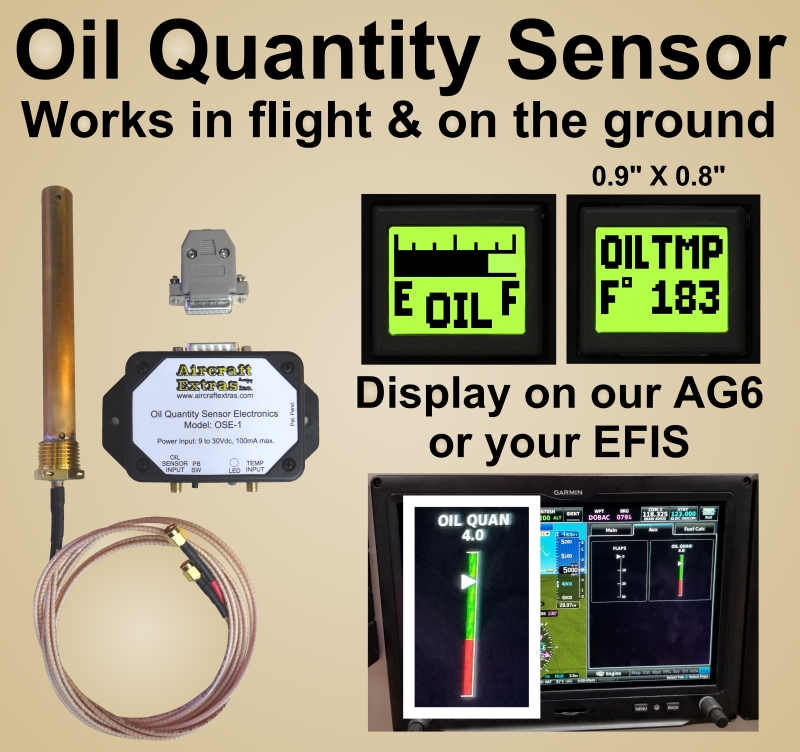
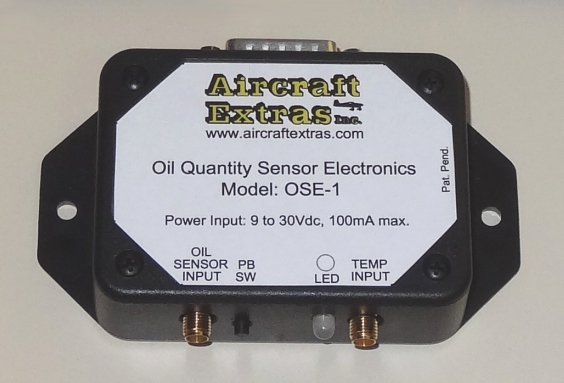
A "complete" oil quantity system consists of the OSE-1
electronics package and an oil quantity sensor. The oil temperature
sensor is now (optional), and is customer selectable (by popular customer
demand). This oil quantity sensor with its associated electronics
package will give the pilot a real time oil quantity while in flight or on the
ground. This system is not meant to replace any other traditional methods of
checking oil quantity. It is a new device that the pilot of a small aircraft can
use in flight that he or she never had before. It will also measure oil
temperature if that option was selected at purchase. The electronics enclosure
features two analog outputs, one for oil quantity and the other for oil
temperature. It also features a four digital output alarms (open collector type)
for sensor malfunction, oil level warning, oil level caution, and over oil
temperature. You may program the alarm trigger values for those outputs and
choose a scaling for both analog outputs.
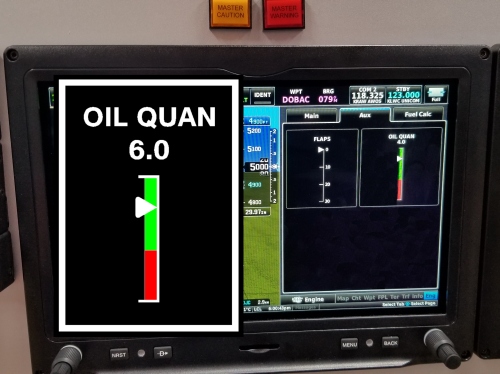
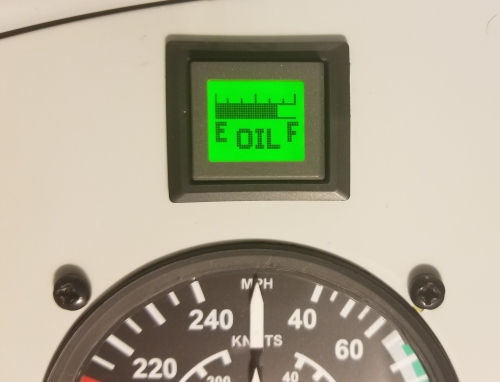
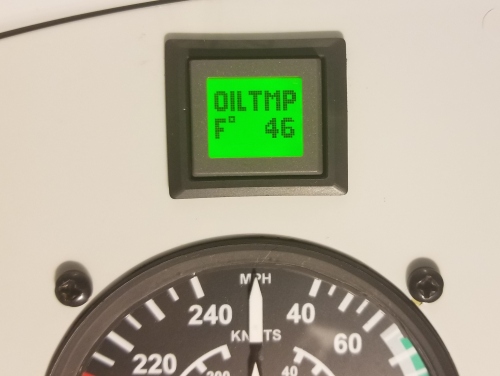
You may choose to display the oil quantity and temperature on
your existing EIS or EFIS system, or utilize our model AG6 pictured above.
Our AG6 is approximately the size of a postage stamp and will also give you
alarms.
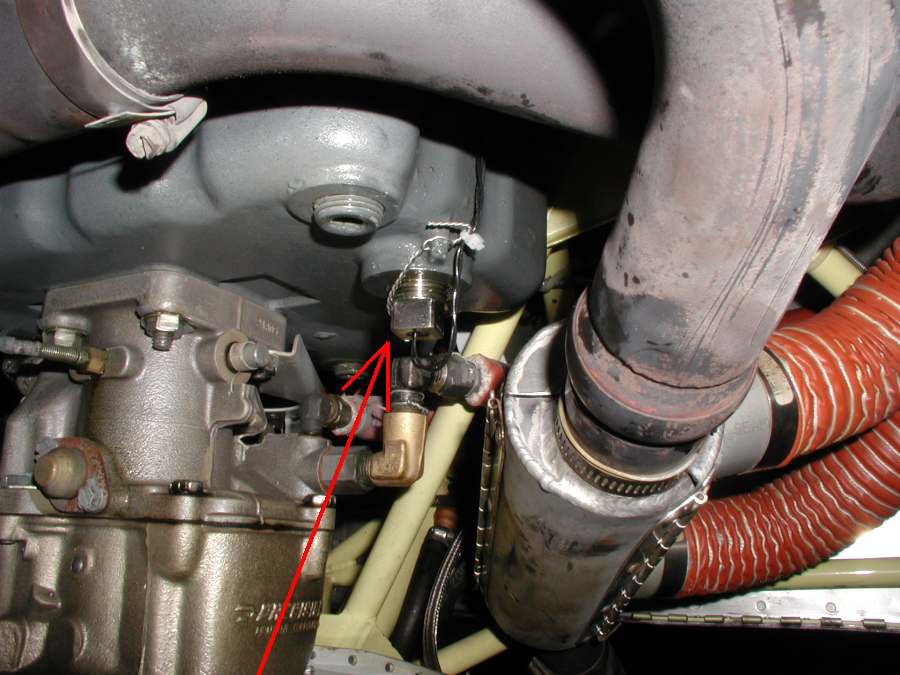
Presently, we have three types of oil sensors available for oil pans for
standard, Lycoming engines, Continental engines, and UL Power engines.
These sensors may fit quite a number of other engines, oil pans, oil sumps and
oil containers. Presently, the length of sensors are custom built. The
sensor's length must be determined by the customer at the time of purchase.
Later, we plan to build them up ahead of time as we
create a database of standard lengths ordered. A list of our available sensor
fitting types are listed further below. Sensors with other fitting types may
already be in our design schedule.
OIL TEMPERATURE SENSOR (optional)
Our standard oil sensor does not include the oil temperature
sensor. This has changed because of popular customer requests. It is (NOW
CUSTOMER OPTIONAL).
This option is selectable at the time or purchase.
WHY PURCHASE THE OIL TEMPERATURE SENSOR
OPTION?
The temperature reading is a bit different from the standard
engine oil temperature. It measures the Oil Sump temperature. The
sensor gives you a good indication what the oil temperature is in the oil sump
area. In general, we have found that this temperature reading is different from
the engine oil temperature. In our O360-A1A engine, the oil sump
temperature rises faster than the engine oil temp. It also runs a bit
hotter than the engine temp, until you get up closer to your cruise phase of flight.
It also gives you a good indication whether the temperature is boiling off
excessive water that remains in your sump. It also makes a good back up for the
normal engine temperature reading.
This unit is great! I had an oil cooler failure and lost 3 quarts of oil
before landing in Santa Paula, CA in my RV-10. I had no idea I was losing oil,
luckily it happened where and when it did otherwise it could have been
disastrous! With a new higher quality oil cooler installed I returned to
Texas. My wife and I were not comfortable with what almost happened. I
discovered the Aircraft Extras Oil Quantity and Temperature Sensor and it was
an easy purchase decision. I also purchased an AG6 Display unit which works
good because of the older avionics I have in my plane. Another RV-10 owner had
a similar experience with an oil cooler failure on a flight home to Texas from
Nebraska. Likewise it was an easy purchase decision for him. He has a Garmin
G3X and uses it to display the quantity. There have been two others on the
field who fly to the Bahamas in their RV-10s that have installed the Oil
Sensors for peace of mind. The units are high quality, well designed, easy to
install, work great and are reasonably priced. Also, I want to thank you for
your technical support.
Happy customer! Richard Jankowski
Published on VANSAIRFORCE forum under: Oil
Quantity Sensor
Yep. Several of us installed one at my airport. Easy to do and works fine as
an emergency warning of unexpected loss. Hooks up to an EFIS system or
separate LED for alerting. We were inspired by two instances of in flight oil
loss in our community (over 40 RV's here). Both cases were in flight oil cooler
failure. One was noticed as pressure dropped and temp rose. Precautionary
landing showed 2 qts of 6 left after 1.5 hrs of flight. Second one showed
nothing in flight (2.5 hr flight). On the ground, oil was seen dripping from
belly. 4 qts. lost. 2qt / hr loss could easily drain a sump on a long flight.
11/2025
I
wanted to take a moment to share something that happened recently—and to thank
you for the role your product played in giving me real peace of mind. After a
three-hour flight, I checked the oil the next morning and found it sitting about
1.5 quarts below what I remembered having at takeoff. I’ll be honest with you:
it scared me. My first thought was that my IO-540 had suddenly started burning
oil at a rate exceeding a quart per hour. It bothered me enough that it kept me
up that night. I went back through every memory I could—trying to recall when I
last added oil, what the level was before taxi, and even driving back out to the
airplane to recheck the dipstick. I pulled up the engine logbook and tried to
piece together any clues. It wasn’t my most scientific work, but at the time it
was all I felt I had. Fortunately, I’ve been pretty disciplined about
downloading engine data from my flights, and that, paired with the Aircraft
Extras "Oil Quantity Sensor", gave me everything I needed. Within a few hours of
digging into the last six months of data, I was able to put my worries to rest.
The trend was stable, the numbers were solid, and my engine was not consuming
oil abnormally at all. The problem wasn’t excessive burn—it was my
misunderstanding of where the engine actually “likes” to run on the dipstick.
Your "Oil Quantity Sensor" turned what could have been weeks of anxiety into a
few hours of calm, data-driven verification. It mattered, a lot.
Thank you, Rich, for creating such an incredibly important and valuable product.
It truly made a difference.
Sincerely, Eric M.
PLEASE READ below before ORDERING!
INSTALLING the
OIL QUANTITY SENSOR (from the TOP or Up-Side-Down)
You
may install the sensor from the top side of your oil pan or oil container but, .
. please be
aware of two situations.
First, please understand that the temperature sensor is mounted in the base of the sensor. This being
the case, it will not function properly because it will not be immersed in the oil
unless the oil tank is always full.
Second, also be aware that when you calibrate the
oil quantity sensor by adding your quarts
of oil, the sensor may not sense your lowest oil level. If this is the case, your
sensor tip may not extend into the oil at the very bottom of your oil pan when
adding your first quart. The oil level must be between the sensor base and the
sensor tip for the first "quantity" of oil. If this is the case, you might try
adding two quarts as your "increment" instead of a one quart increment. This may
allow you to get the oil level beyond the tip of the inverted sensor. It
is up to the installer/customer to determine where your lowest oil level is for
your installation for an inverted sensor installation.
WILL this OIL SENSOR
FIT?
We
would like to make certain that the sensor that you order will fit your
aircraft. If you order one of our standard available sensors, and the
sensor never
had oil in it, or it didn't have scars from installation, we may be able to
refund your money if you make a mistake ordering. However, if you order a
custom made sensor and find that it does not fit, we will not be able to refund
your money for the sensor portion of your order.
SENSOR with (14MMx1.5) threaded fitting, (ULPower Type)
NOTE: "ULPower Aero Engines"
Our sensor "will work" for the newer 520 type engines that have a cast oil pan.
These engines have a vertical oriented oil plug fitting hole.
Other ULPower Aero Engines have only drain holes or fittings that are only
horizontally oriented. Unfortunately, our sensor will not work for those
types of engines. Talk to the ULPower Aero Engine company for solutions so
you can utilize our sensor.
NOTE: We cannot presently offer the Temperature Sensor with this type of
fitting. The fitting bottom area is too small. We are working on
some solutions to this problem.
Presently, the 260 and 350 engines have horizontal oil pan fitting holes.
Our sensor will not work mounted horizontally. If ULPower modifies their
oil pans, our sensors may be made to work. You might ask ULPower if their
present oil pan ban be modified to work for these two models.
Sensor Model: Sxx.x_(14MMx1.5)_ (xx.x = sensor length in inches) $205.00
(OSE-1 is required to drive the sensor)
Price below is total price with
shipping. Select shipping before adding to cart
NOTE: We recommend a maximum distance of 72 inches between the
electronics OSE-1 and the sensor. If you require a longer distance, please
contact us. Contact us if you also require a custom length extension cable
can be ordered.
Cable Model: CabSMA30.0 $28.00
Cable Extension 30" (SMA male connector on
one end, female on the other)
Price below is total price with
shipping. Select shipping before adding to cart.
Cable Model: CabSMA15.0 $22.00
Cable Extension 15.0" (SMA male connector
on one end, female on the other)
Price below is total price with
shipping. Select shipping before adding to cart.
This is a partial list of oil plug
thread sizes for various engines. It may help others determine the proper thread
for your sensor application. It is ONLY for reference and needs further
verification. If any of you have any inputs or suggestions in order to complete
or add to this list, please contact us. We have sensors that will fit the
thread sixes below that are RED. We will
design others as needed.